
$0$0
The Great Wildebeest Migration, Maasai Mara to Serengeti
The Great Wildebeest Migration is one of Africa’s most extraordinary wildlife spectacles and one of the world’s great natural movements. Each year, vast herds of wildebeest, accompanied by large numbers of zebra and other grazing animals, move through the Serengeti-Mara ecosystem, crossing between northern Tanzania and southern Kenya in search of fresh grazing and water.
Rather than being a single event that happens on one particular date, the migration is a continuous annual cycle. The herds move through different parts of the Serengeti and Maasai Mara according to rainfall, grass availability, water, and seasonal conditions.
Discover the Great Migration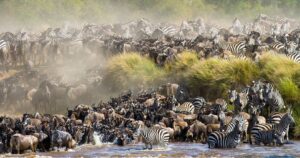
The migration begins its annual cycle in Tanzania, with the southern Serengeti and Ngorongoro ecosystem providing important grazing and calving areas. Around February, large numbers of wildebeest gather on the nutrient-rich short-grass plains, where hundreds of thousands of calves can be born within a short period.
As the year progresses, the herds gradually move northwards through the Serengeti before reaching Kenya’s Maasai Mara, where they typically spend part of the dry season. The movement eventually turns south again, bringing the animals back into Tanzania and continuing the cycle.
The wider Serengeti-Mara ecosystem covers approximately 30,000 square kilometres and includes the Serengeti National Park, Ngorongoro Conservation Area, Maasai Mara National Reserve, and surrounding protected areas and wildlife habitats.
The Great River Crossings
One of the most dramatic moments of the migration occurs when the herds reach major rivers, particularly the Mara River between Tanzania and Kenya.
Thousands of wildebeest may gather along the riverbanks before attempting to cross. The crossings can be chaotic and unpredictable, with animals navigating steep banks, strong currents, crocodiles, and the pressure of enormous herds moving together.
The exact timing and location of crossings cannot be guaranteed because the migration follows natural environmental conditions rather than a fixed schedule.
The Migration Cycle
Calving Season
Around February, the herds gather in the southern Serengeti and surrounding plains for the calving season. The abundance of nutritious grass provides important conditions for pregnant wildebeest and newborn calves. TANAPA estimates that more than 250,000 calves may be born during the annual calving period.
Moving Through the Serengeti
Following the calving season, the herds gradually move through the Serengeti as they respond to changing rainfall and grazing conditions. This period provides excellent opportunities to witness large concentrations of wildebeest, zebra, and predators.
Crossing Into Maasai Mara
Between roughly July and October, significant numbers of wildebeest move into Kenya’s Maasai Mara ecosystem. Kenya Wildlife Service notes that the migration into Kenya generally occurs during this period, although the number of animals and exact timing vary from year to year.
Returning to Tanzania
After spending time in the Maasai Mara ecosystem, the herds eventually begin moving southwards again, returning into Tanzania and continuing the annual cycle.
Wildlife Along the Migration
The movement of millions of grazing animals supports one of Africa’s richest predator-prey ecosystems. Lions, cheetahs, leopards, hyenas, crocodiles, and other predators take advantage of the abundance of prey.
The migration also plays an important ecological role. Wildebeest consume huge quantities of grass, redistribute nutrients through grazing and dung, and help maintain the productivity of the Serengeti-Mara grasslands.
When Is the Best Time to See the Migration?
There is no single best month for the entire migration because different stages occur in different parts of the ecosystem.
February to March: Best associated with the calving season in the southern Serengeti.
June to July: Herds move through central and western parts of the Serengeti as they begin their northward journey.
July to October: Often associated with the Maasai Mara and Mara River crossing period, although timing varies depending on rainfall and environmental conditions.
October to November: The herds begin moving south again toward Tanzania.
The Maasai Mara and Serengeti Connection
The Maasai Mara and Serengeti should not be viewed as two completely separate wildlife destinations. They form part of one interconnected ecosystem through which the migration moves throughout the year.
The Serengeti provides vast grazing landscapes and important calving grounds, while the Maasai Mara becomes an important dry-season destination for the herds. Together, they create one of the world’s most remarkable examples of large-scale wildlife movement.
A Destination Shaped by Nature
Unlike a scheduled event, the Great Migration is controlled by nature. Rainfall, water availability, grass growth, and environmental conditions determine where the animals move.
This unpredictability is part of what makes the experience so extraordinary. A safari may involve watching thousands of animals moving across open plains one day and waiting quietly beside a river for a crossing that may or may not happen the next.
Why Experience the Great Migration?
The Great Wildebeest Migration offers one of the most powerful wildlife experiences in Africa. It combines enormous herds, dramatic landscapes, predator encounters, river crossings, and the opportunity to witness an ecological cycle that has continued for generations.
For travelers interested in African wildlife, safari, nature, photography, and conservation, following the migration between the Serengeti and Maasai Mara provides an unforgettable journey through one of Africa’s greatest ecosystems.
The Great Migration at a Glance
Location: Serengeti, Tanzania & Maasai Mara, Kenya
Region: East Africa
Ecosystem: Serengeti-Mara Ecosystem
Main Species: Wildebeest, zebra and other grazing animals
Best Known For: Annual wildlife migration, calving season and river crossings
Best Time: Varies by migration stage, with July to October commonly associated with the Maasai Mara
Best For: Wildlife, safari, photography, nature and conservation
No results found!